Debris Flow Simulation and Mitigation Design for TRA North-Link Line K48 Section
Construction methods · Project management · AEC industry
Researchers applied RAMMS numerical modeling to simulate post-2024 Hualien earthquake debris flow cascades along TRA's North-Link Line K48, assessing the protective performance of proposed retention and diversion countermeasures.
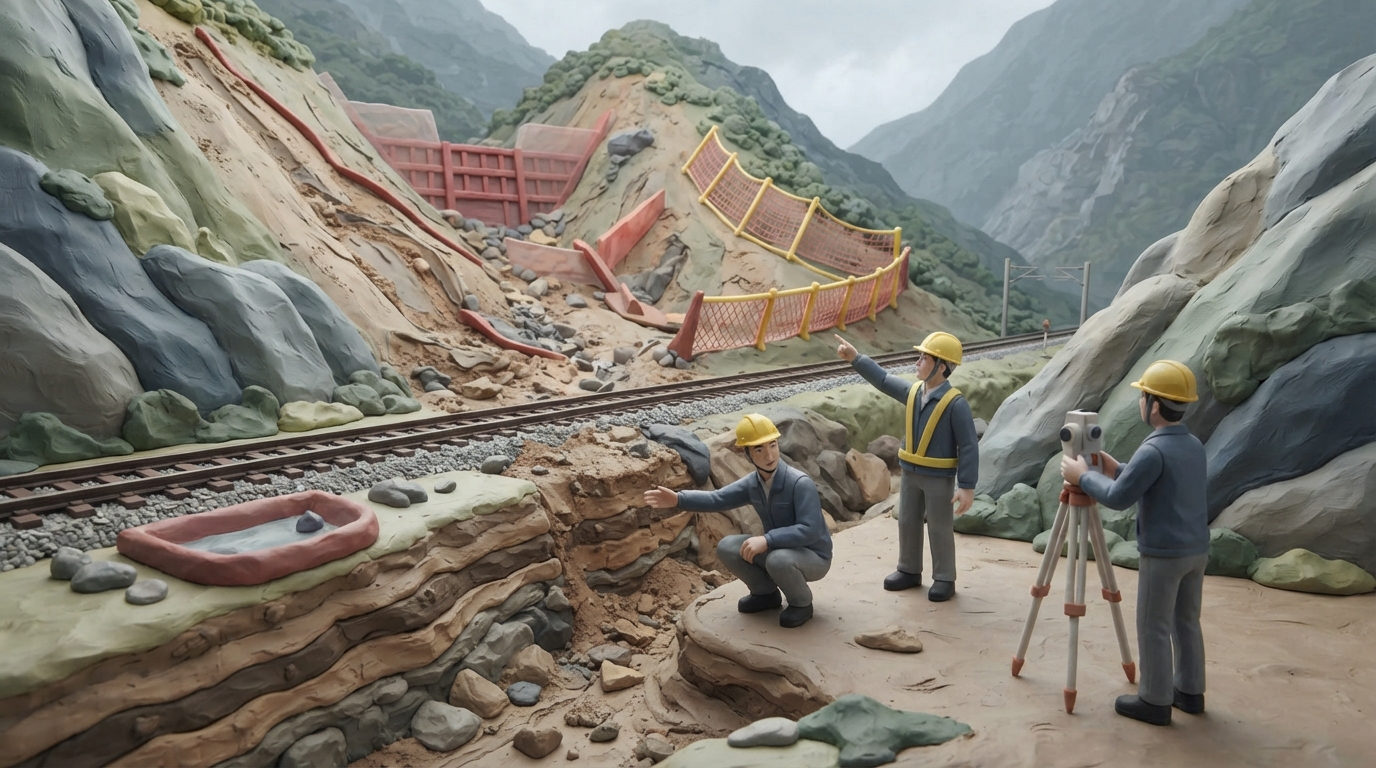
Following the April 3, 2024 Hualien earthquake, a joint research team from NYCU, NTU, Taipei Tech, and CECI evaluated the debris flow disaster chain impacting the K48 section of the Taiwan Railway North-Link Line near Heren Station. Published in the Journal of the Chinese Institute of Civil and Hydraulic Engineering, the paper presents a sequential RAMMS::Debrisflow modeling methodology that stacks simulated deposition onto successive digital elevation models to evaluate mitigation effectiveness under multiple hazard scenarios.
Key takeaways
- The study utilized RAMMS::Debrisflow with the Voellmy rheological model, updating subsequent elevation surfaces with earlier deposition results to capture topographic evolution across three consecutive 2024 debris flow events.
- DEM difference (DOD) analysis indicated approximately 45,000 cubic meters of erosion and 27,000 cubic meters of unstable residual slope material, matching closely with back-calculated outflow volumes.
- Simulations demonstrated that single-agency interventions fail to fully shelter railway tracks, whereas a joint mitigation scheme diverts principal flows northward and largely halts debris before tracks.
- Under a scenario where all 29,000 cubic meters of residual sediment wash out, railway-area accumulation reaches 19,585 cubic meters, nearing the 22,000-cubic-meter retention capacity limit without structural failure modeling.
Source:中國土木水利工程學會|土木水利 Read the original ↗
Prepared, checked and automatically published by AI; not individually reviewed by a human. Translation checked by AI.