Discussion on Component Storage and Reassembly Site Options for Taipei's Historic Zhongshan Bridge
AEC industry · Structures
An article in Civil and Hydraulic Engineering reviews the storage status and reassembly proposals for Taipei's historic Zhongshan Bridge. Dismantled in 2003, the reinforced concrete arch bridge's 435 components remain stored at the former Zaichun Swimming Pool site. While Taipei City has evaluated candidate schemes including the Zaichun site, Dajia section, and Xinsheng Park, the author examines sites around Yuanshan and Jiantan to assess the feasibility of rebuilding it as a pedestrian bridge.
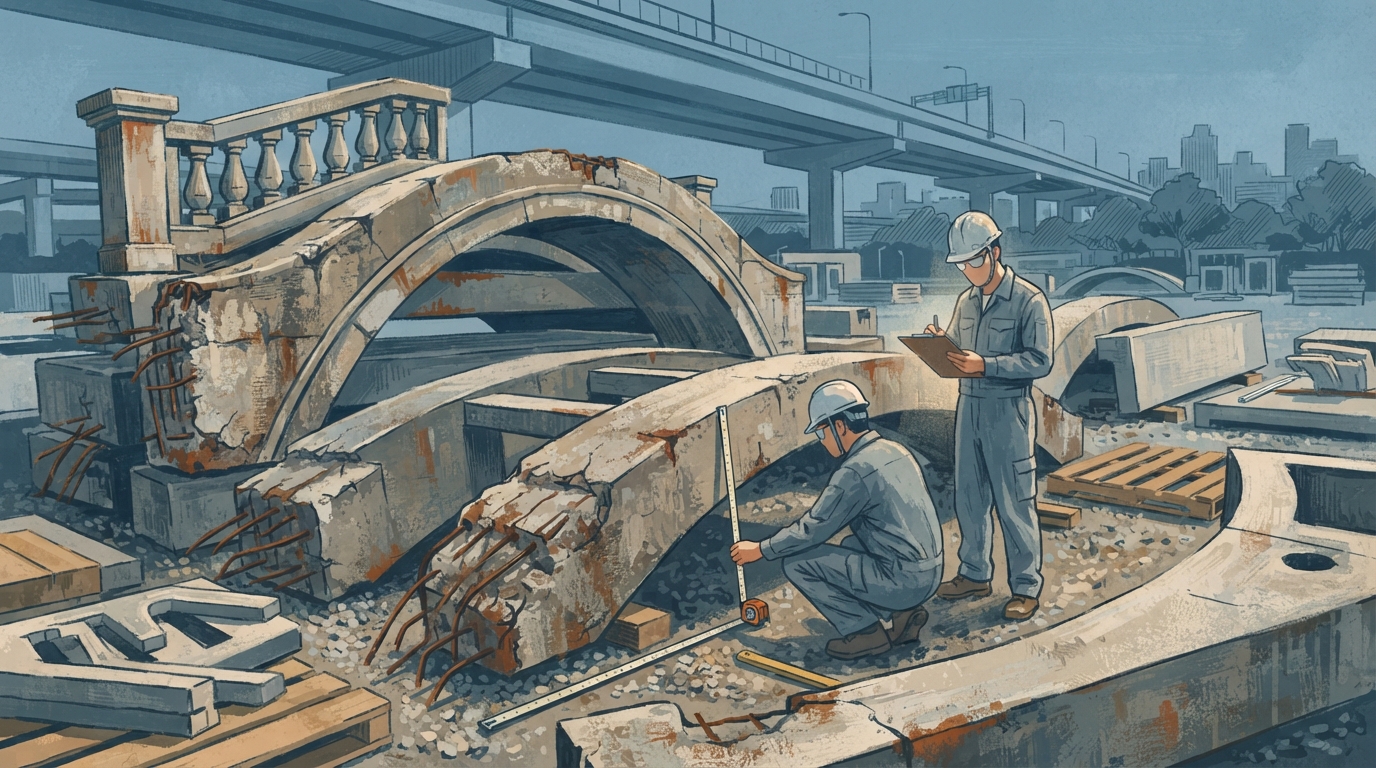
An article published in the June 2026 issue of Civil and Hydraulic Engineering examines the dismantling history and stalled reconstruction of Taipei's historic Zhongshan Bridge. Originally built in 1933 as a three-span reinforced concrete arch bridge, it faced flood-control scrutiny following Typhoon Nari in 2001. The Taipei City Government resolved to dismantle the bridge in 2002 and finished cutting it into 435 structural pieces by April 2003, which remain stored under the Xinsheng Elevated Bridge. The author reviews previous municipal evaluation schemes from 2020, assesses site conditions around Yuanshan and Jiantan for reassembly as a pedestrian footbridge, and advocates establishing a dedicated decision committee to resolve the long-stalled project.
Key takeaways
- Rebuilt in 1933 as a reinforced concrete arch bridge, Zhongshan Bridge was dismantled by April 2003 for flood safety, with 435 cut pieces stored at the former Zaichun Pool site to date.
- In 2020, Taipei's Cultural Heritage Review Committee conditionally passed three reassembly schemes: the Zaichun site, the Dajia floodway section, and Xinsheng Park.
- The author evaluates park grounds around Yuanshan and Jiantan, noting that material testing was completed and reassembly as a pedestrian bridge reduces load demands, making it technically feasible.
- The article recommends establishing a decision committee guided by the Bureau of Cultural Heritage and Taipei City Government alongside civil and heritage engineering experts.
Source:中國土木水利工程學會|土木水利 Read the original ↗
Prepared, checked and automatically published by AI; not individually reviewed by a human. Translation checked by AI.