UEL Researchers Develop AI Framework Integrating Soil and Structure for Seismic Risk Assessment
Structures · Frontier AI models
University of East London researchers have introduced an AI-assisted framework that combines soil conditions, ground shaking, and structural strength into a unified workflow. Tested on a five-storey concrete model using historical Northridge and Kobe earthquake records, the workflow revealed non-linear responses between shaking and building movement, though practical engineering adoption still requires testing across broader datasets.
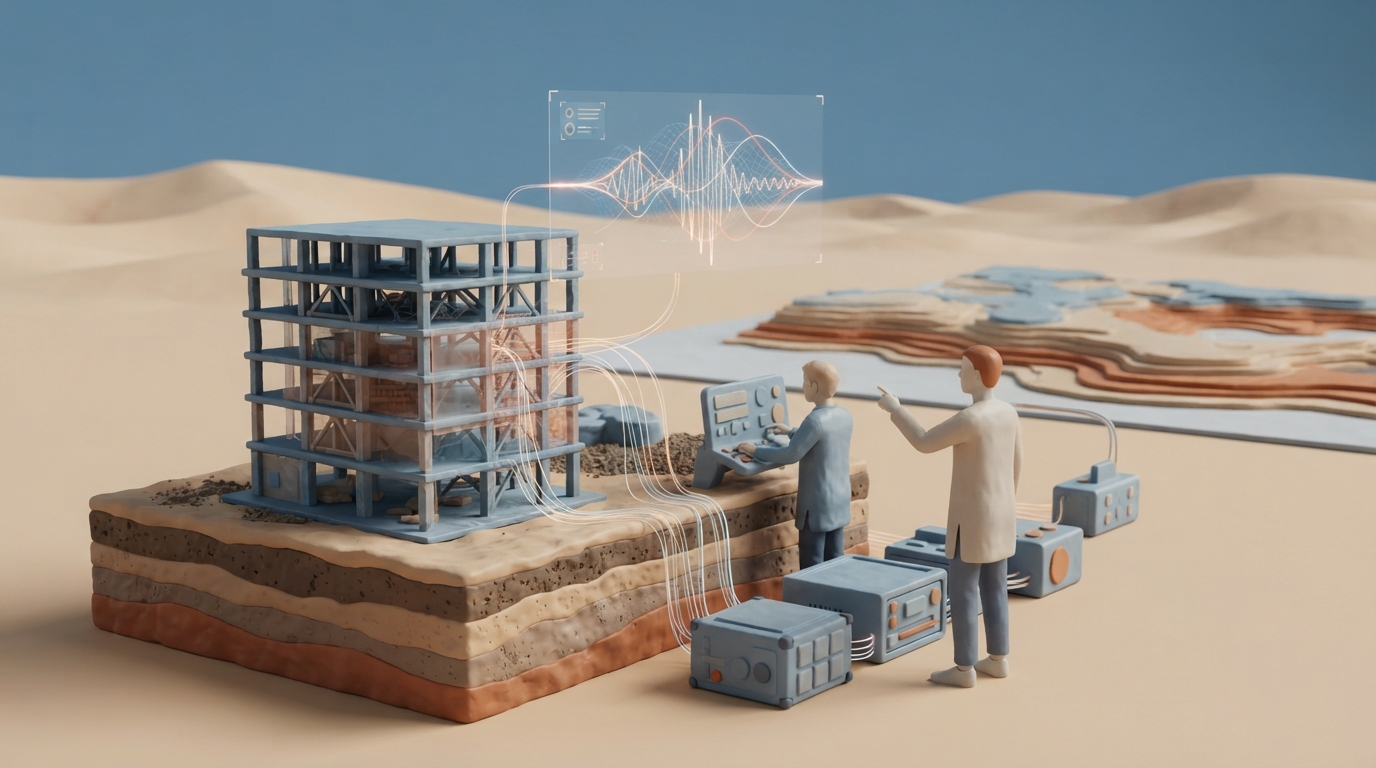
Researchers at the University of East London (UEL), led by Dr Jawed Qureshi, have developed an AI-assisted framework to evaluate earthquake risks by integrating soil conditions, seismic shaking, and structural capacity into a single workflow. Structural engineers conventionally evaluate the ground, dynamic movement, and individual structural components using isolated tools, complicating the assessment of how these interacting factors affect performance. The study evaluated a computer model of a five-storey reinforced concrete building using ground-motion records from the 1994 Northridge and 1995 Kobe earthquakes. Utilizing a supervised Proto-Artificial General Intelligence (Proto-AGI) workflow uniting four specialized technologies, the analysis found that while the Northridge event generated roughly 3.4 times the median seismic demand of the Kobe record at the structure's natural period, peak structural movement differed by only 1.32 times. The findings demonstrate that ground shaking does not scale linearly into structural displacement. The research team emphasized that the framework is intended to inform rather than replace human engineering judgment. Because the initial study was restricted to one soil profile and two earthquake records with manual coordination between technologies, the researchers noted that routine engineering use will require further validation across larger datasets, higher automation, and structural monitoring inputs.
Key takeaways
- UEL researchers developed an AI-assisted framework combining soil characteristics, ground shaking, and structural strength under human supervision.
- A simulation of a five-storey building showed that a 3.4-fold difference in seismic demand between Northridge and Kobe records resulted in only a 1.32-fold difference in peak movement.
- The research team stated the system aims to augment rather than replace human engineering judgment by revealing structural vulnerabilities holistically.
- Practical engineering adoption requires additional research, as the initial tests evaluated only one soil profile and two historical earthquake datasets.
Source:Construction Management Read the original ↗
Prepared, checked and automatically published by AI; not individually reviewed by a human.