SETI and Breakthrough Listen Deploy Agentic AI to Automate Radio Telescope Observations
AI assistants
The SETI Institute and Breakthrough Listen are integrating agentic AI at the Allen Telescope Array in Northern California. Powered by NVIDIA Holoscan and RTX PRO 6000 Blackwell GPUs, the system processes sensor data at 2.4 terabits per second directly in GPU memory, enabling AI agents to steer antennae, calibrate instruments, and process signals in real time through natural language prompts.
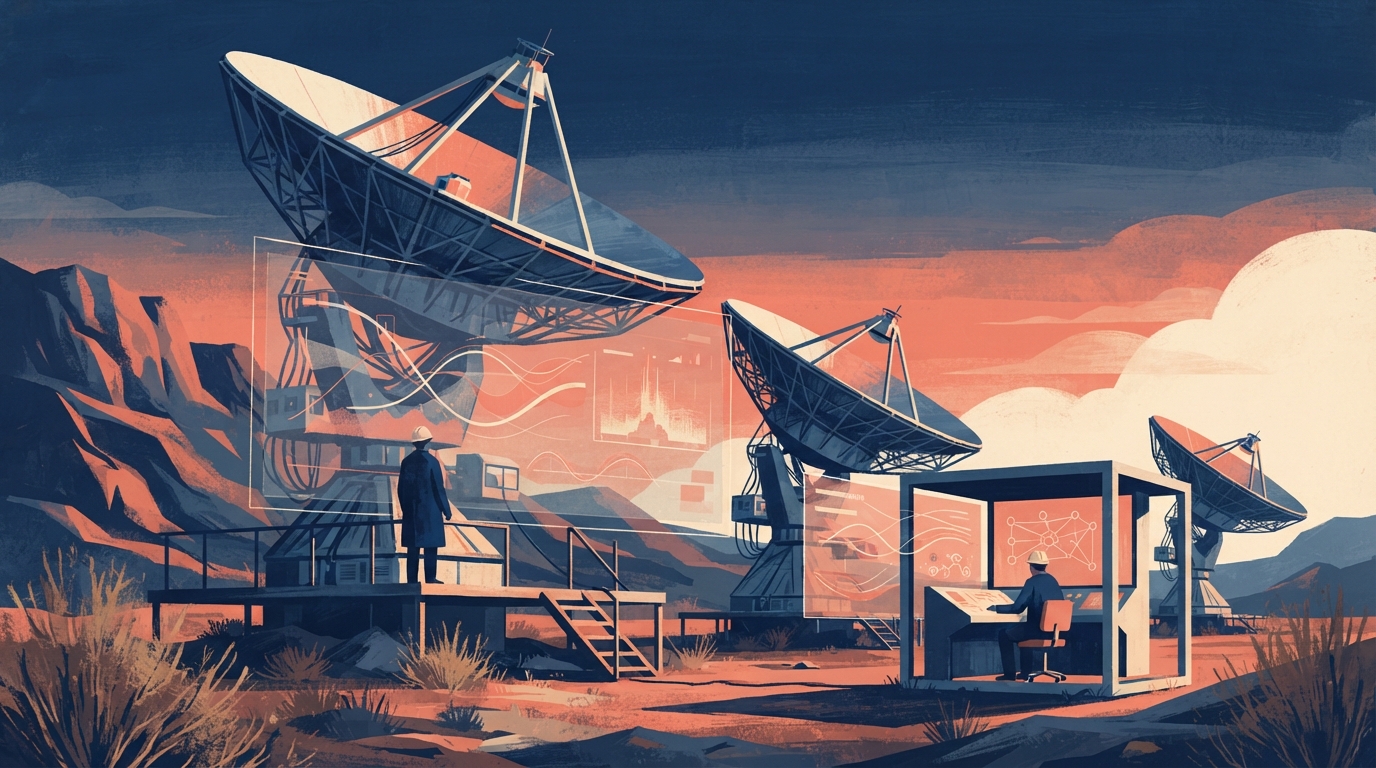
Breakthrough Listen and the SETI Institute have introduced agentic AI into astronomical research at the Allen Telescope Array in Northern California. According to NVIDIA, AI agents can now steer radio telescope antennae, enhance and correct incoming data streams, and run AI models from a single natural language request. The architecture utilizes the NVIDIA Holoscan platform library DAQIRI, allowing sensor data to stream directly into GPU memory for on-the-fly processing rather than storing raw data on disk. CyberEther, a signal-processing framework created by the SETI Institute, performs calculations using NVIDIA CUDA-X libraries including cuFFT and cuBLAS. A web-based orchestrator called Nexus acts as the agent harness, providing instrument state and compute pipeline controls via natural language prompting. Operating on-premises beside the telescope with NVIDIA RTX PRO 6000 Blackwell GPUs, the system handles up to 2.4 terabits per second. The pipeline demonstrated real-time AI detection of a pulsar in the Crab Nebula, and researchers are evaluating open models like NVIDIA Nemotron for future low-latency and offline deployments.
Key takeaways
- AI agents at the Allen Telescope Array can steer antennae, calibrate instruments, and analyze signals via natural language requests.
- NVIDIA Holoscan and CyberEther stream and compute up to 2.4 terabits per second directly in GPU memory using RTX PRO 6000 Blackwell GPUs.
- The Nexus orchestrator allows researchers to inspect spectrograms and rewrite signal-processing blocks using text prompts.
- The system achieved real-time AI detection of a Crab Nebula pulsar, with teams testing models like Nemotron for offline edge use.
Source:NVIDIA Blog Read the original ↗
Prepared, checked and automatically published by AI; not individually reviewed by a human.