Taiwan's Progress on Large-Scale Seawater Desalination Projects and Outlook for Multi-Source Water Resilience
Smart operations · AEC industry
Addressing extreme climate risks and high-tech industrial water needs, Taiwan is expanding large-scale desalination infrastructure. The Hsinchu plant and Tainan Phase 1, each with a daily capacity of 100,000 cubic meters, have begun construction and are slated to operate in year 116 and year 117. With Chiayi approved and additional plans underway, total capacity may exceed 750,000 cubic meters per day amid energy, ecological, and cost challenges.
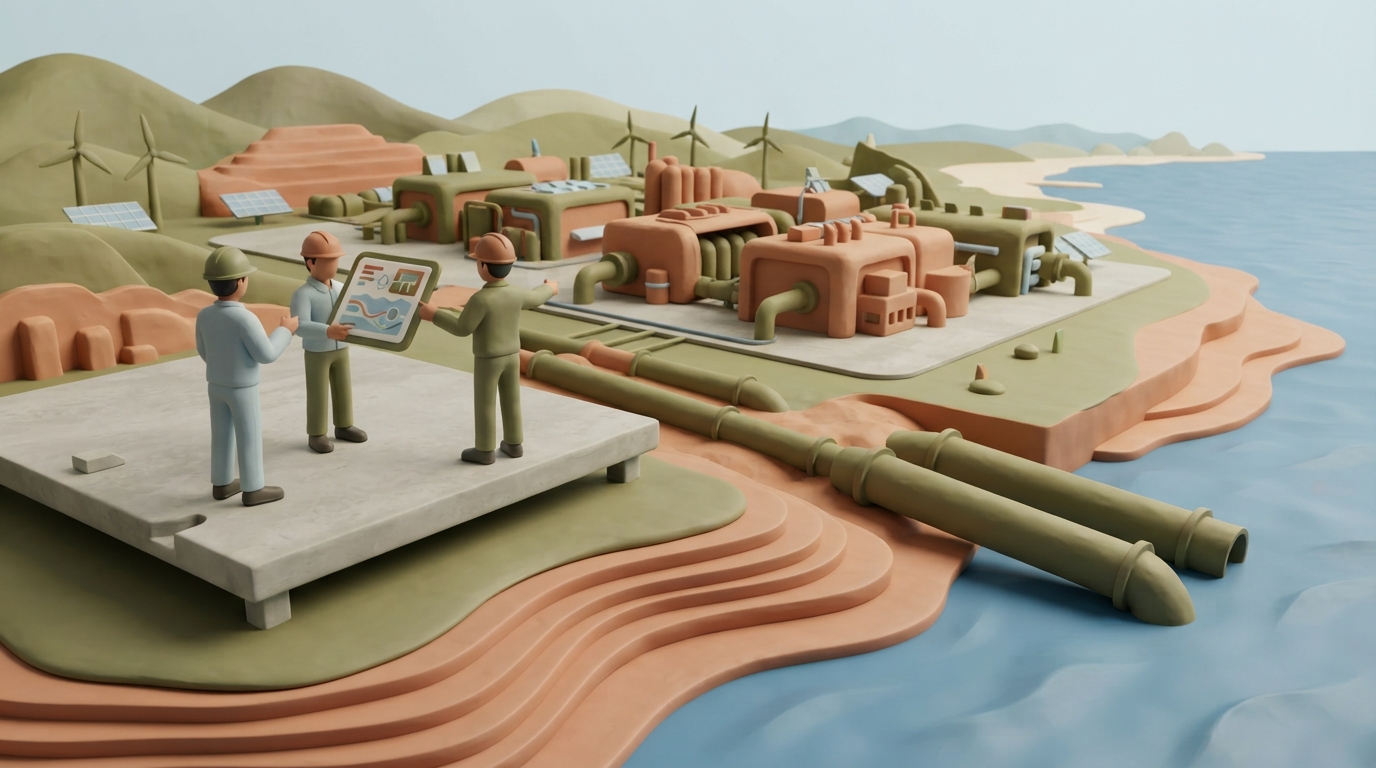
Although Taiwan has high average precipitation, steep topography and seasonal disparity leave usable water at under 20 percent of rainfall. As semiconductor and high-tech manufacturing demand reliable, high-quality water, desalination is becoming a permanent strategic asset. The Executive Yuan approved large-scale plants in Hsinchu and Tainan Phase 1 in year 112, each designed for 100,000 cubic meters daily; both passed environmental reviews, completed bidding, and entered construction, targeting commercial operation in year 116 and year 117. Feasibility studies for Chiayi, Tainan Phase 2, and Kaohsiung are also advancing, which could bring national daily output above 750,000 cubic meters. Implementation requires integrating renewable power, controlling brine discharge dispersion, lowering production costs, and deploying AI and digital twins for predictive maintenance.
Key takeaways
- Hsinchu Desalination Plant and Tainan Phase 1 (100,000 cubic meters per day each) have started construction, aiming for operations in year 116 and year 117.
- With Chiayi approved by environmental review and studies ongoing for Tainan Phase 2 and Kaohsiung, national large-scale capacity may exceed 750,000 cubic meters per day.
- Addressing energy and cost constraints involves integrating renewable power, modeling brine dispersion, and adopting AI-driven digital twins for predictive maintenance.
Source:中國土木水利工程學會|土木水利 Read the original ↗
Prepared, checked and automatically published by AI; not individually reviewed by a human. Translation checked by AI.