Landslide Remediation and Damaged Tunnel Reconstruction on Taiwan Railway Jiji Line
Structures · Construction methods · AEC industry
Following severe rain-induced landslides on Taiwan Railway's Jiji Line between K23+720 and K23+845 that damaged Tunnels No. 2 and No. 3, engineers utilized LiDAR and drilling surveys to assess colluvium failure mechanisms. The rehabilitation combined crown anchoring, subsurface drainage, slope grading, and cut-and-cover tunnel reconstruction supported by bored piles and tieback anchors, achieving structural tunnel completion ahead of schedule in October of Year 114.
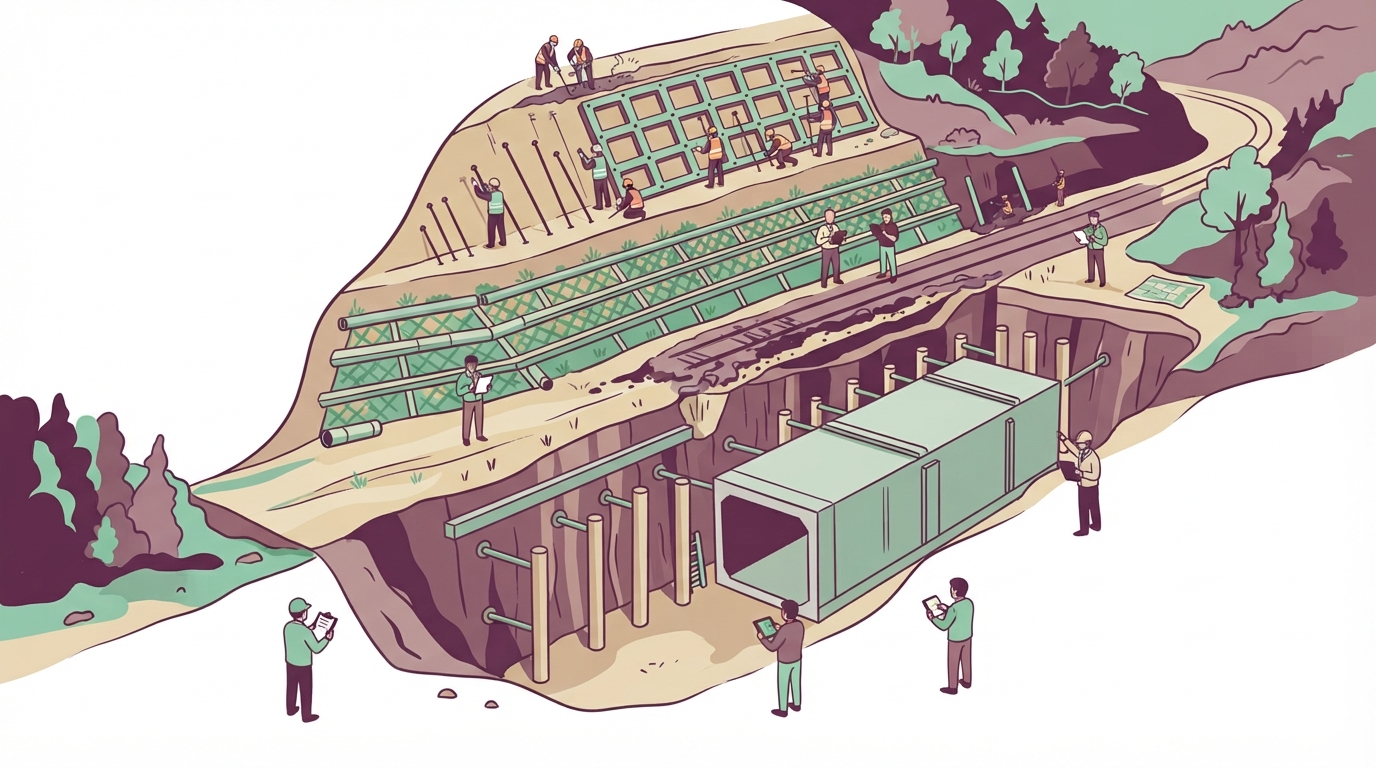
Tunnels No. 2 and No. 3 on Taiwan Railway's Jiji Line, situated between Jiji and Shuili in Nantou County, sustained severe structural deformations, lining spalling, and soil intrusion after repeated rainfall-triggered slope failures in Year 110 and Year 111. Site surveys indicated that the ground consists of thick, poorly cemented terrace deposits subject to complex shallow debris slides and deep circular slip surfaces, with overburden loads increasing by 2.5 to 3 times. The engineering team deployed a comprehensive stabilization strategy: installing 35-meter ground anchors with reinforced concrete retaining walls at the landslide crown, integrating horizontal drain pipes and graded slope greening, and implementing cut-and-cover tunnel construction using bored pile walls with multi-stage tieback prestressed anchors. The cut-and-cover tunnel structure achieved completion ahead of schedule on October 28 of Year 114, facilitating trial train runs in April of Year 115.
Key takeaways
- Due to extreme rainfall escalating overburden loads by 2.5 to 3 times and causing severe lining spalling, the degraded brick tunnels were replaced with a new cut-and-cover tunnel structure.
- Slope stabilization incorporated 35-meter ground anchors with concrete walls at the crown, horizontal drain pipes, surface runoff diversion, and frame-lattice bioengineering anchors.
- Cut-and-cover construction used bored contiguous pile walls with two-stage prestressed anchor tiebacks, thickened base slabs for fault-zone seismic resistance, and Type II cement for corrosion protection.
- The engineering team completed the cut-and-cover new tunnel structure ahead of schedule on October 28 of Year 114, and initiated trial test runs with diesel locomotives on April 29 of Year 115.
Source:中國土木水利工程學會|土木水利 Read the original ↗
Prepared, checked and automatically published by AI; not individually reviewed by a human. Translation checked by AI.