Planning, Design, and Turnkey Execution of Hsinchu Desalination Plant
BIM collaboration · Construction methods · AEC industry
Designed with a capacity of 100,000 CMD, the Hsinchu Desalination Plant is Taiwan's first publicly initiated large-scale facility, executed under a turnkey model covering 15 years of O&M (extendable by 10 years). Tailored to local marine conditions, the process adopts pigging instead of chlorination, DAF over sedimentation, and DMPF instead of UF, paired with split-pass two-pass RO for boron removal. BIM is integrated during construction under a 1,350-day contract.
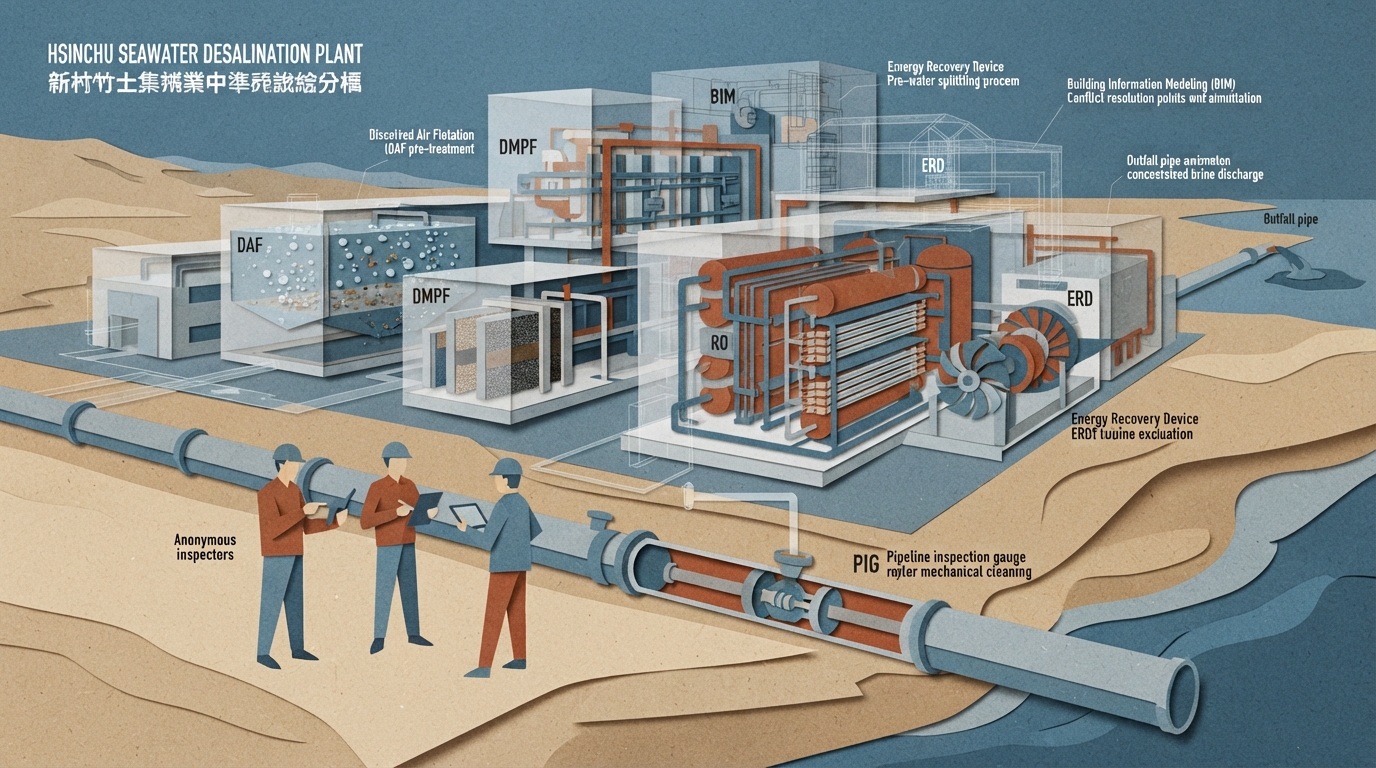
To enhance water resilience against climate variability, the Northern Region Water Resources Branch executed the Hsinchu Desalination Plant turnkey contract, featuring a net design output of 100,000 CMD as Taiwan's first municipal large-scale seawater desalination facility. With a total budget of 12 billion, the project scope covers design, construction, and 15 years of post-completion operation and maintenance, with an option for a 10-year extension. Addressing local seawater challenges such as elevated salinity, high boron levels, and seasonal algae and suspended solids, the design adopts tailored process optimizations: the intake pipeline implements a mechanical pipeline inspection gauge (PIG) system operated roughly once per year to avoid chemical chlorination; pretreatment employs dissolved air flotation (DAF), saving approximately 85% footprint over sedimentation basins while cutting coagulant dosage by over 33%; filtration replaces ultrafiltration membranes with dual-media pressure filters (DMPF), eliminating chemical cleaning and membrane replacement while recycling 400,000 cubic meters of brine annually for backwashing. The core desalination line utilizes a split-pass two-pass reverse osmosis (RO) system with pH adjustment to limit product boron concentrations to ≤1.0 mg/L, recycling lower-salinity second-pass brine into the first-pass feed. Energy recovery devices (ERD) with a 97% transfer efficiency are installed alongside a gravity-head brine discharge design to cut pumping energy. Under a 1,350-day contract timeline targeting completion in March of ROC year 117, construction management incorporates Building Information Modeling (BIM) to resolve spatial clashes, plan safety simulations for confined spaces, and support future O&M training. The instrumentation and control system enables 99% automated operations.
Key takeaways
- Planned capacity reaches 100,000 CMD under an EPC contract including 15-year O&M (extendable by 10 years) with a 12 billion budget.
- Pretreatment applies DAF and DMPF while intake piping uses mechanical PIG cleaning, reducing footprint and chemical consumption.
- Main treatment uses split-pass two-pass RO to keep boron ≤1.0 mg/L, combined with isobaric ERDs for energy efficiency.
- BIM is deployed across construction for spatial clash detection and safety simulation, supporting 99% automated plant operations.
Source:中國土木水利工程學會|土木水利 Read the original ↗
Prepared, checked and automatically published by AI; not individually reviewed by a human. Translation checked by AI.