AI Prediction and Cell-Level Monitoring Drive Battery Safety and R&D Transformation
Enterprise AI · Smart operations
The battery industry is transitioning from passive defense to predictive lifecycle management. Samsung SDI plans to deploy its SBI platform in ESS by late 2026 to detect anomalies. UM researchers predict battery lifespan using early cycle data and physics simulations, requiring an estimated 5% energy and 2% time, while Hyundai introduces ADI's wireless BMS on the Genesis GV90 for real-time cell tracking.
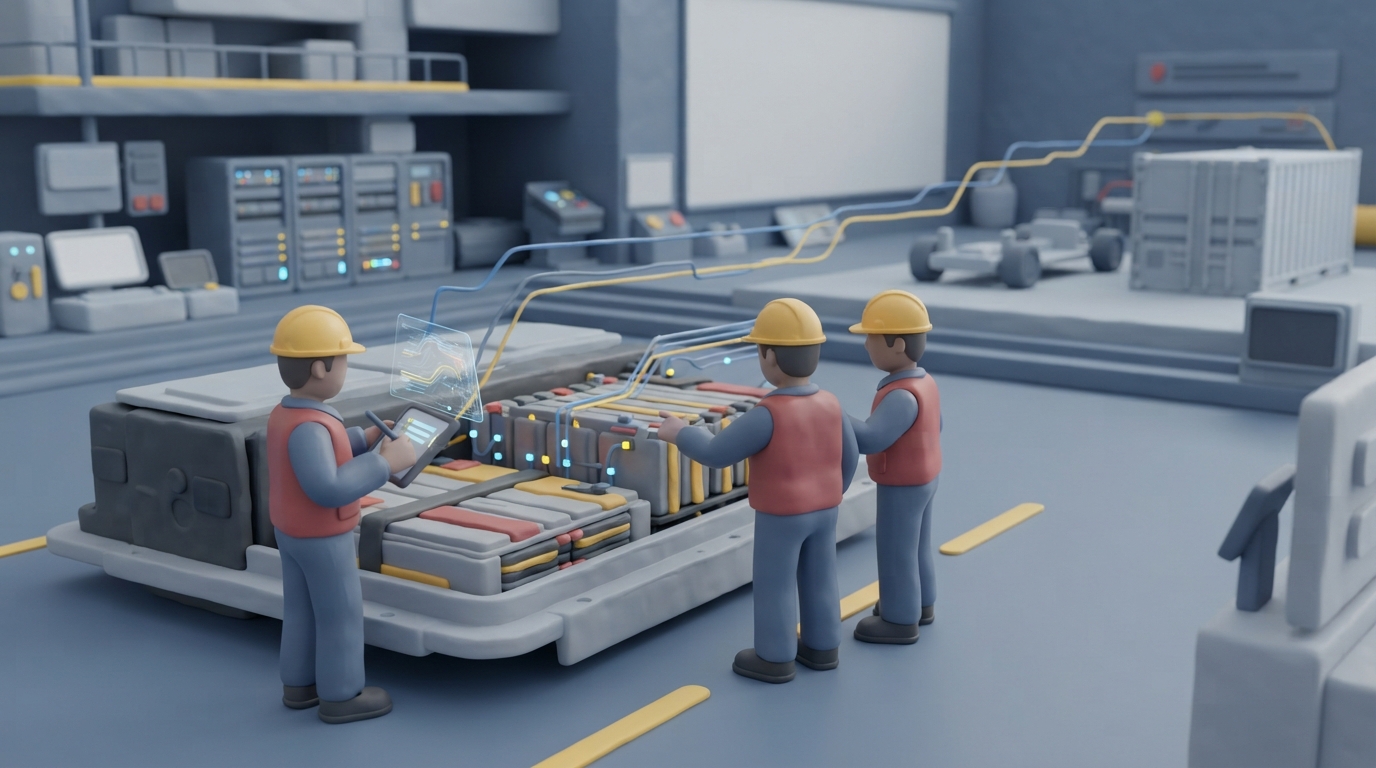
The expansion of the energy transition and electric vehicles is driving shifts in battery safety, development methods, and management architectures. In safety management, Samsung SDI plans to introduce the Samsung Battery Intelligence (SBI) AI platform into energy storage systems (ESS) by late 2026, leveraging field operation data and simulation models to predict cell anomalies and assess remaining life before failures occur. In testing, developing diverse chemistries like high-nickel, LFP, and solid-state batteries through physical prototyping has become costly. Samsung SDI is incorporating synthetic simulation data into AI training. Additionally, a University of Michigan research team published a discovery learning approach in Nature that requires only the first 50 charge-discharge cycles combined with historical data and physical models to forecast lifespan down to 90% capacity, estimating that it requires only about 5% of the energy and 2% of the time compared to full testing. For on-vehicle deployment, Hyundai Motor adopted Analog Devices' (ADI) wireless battery management system (wBMS) in the Genesis GV90. Using chips attached directly to cells, the system enables real-time cell-level tracking, providing granular data streams for edge and cloud AI diagnostics.
Key takeaways
- Samsung SDI plans to deploy the SBI platform in ESS by late 2026, integrating operational and simulation data to forecast cell anomalies.
- A University of Michigan team predicted battery degradation using 50 early cycles and physics models, estimating it requires only about 5% energy and 2% time compared to full testing.
- Hyundai Motor implemented ADI's wireless BMS on the Genesis GV90 to enable cell-level tracking, supplying data for AI-driven fault detection.
Source:科技報橘 Read the original ↗
Prepared, checked and automatically published by AI; not individually reviewed by a human. Translation checked by AI.