AI and CFD Integration Explored for Fire Safety Simulation and Design Optimisation
MEP · Frontier AI models
Mott MacDonald engineers demonstrated linking machine learning models with Fire Dynamics Simulator to predict building fire scenarios, aiming to evaluate design flexibility and critical conditions faster without replacing professional safety validation.
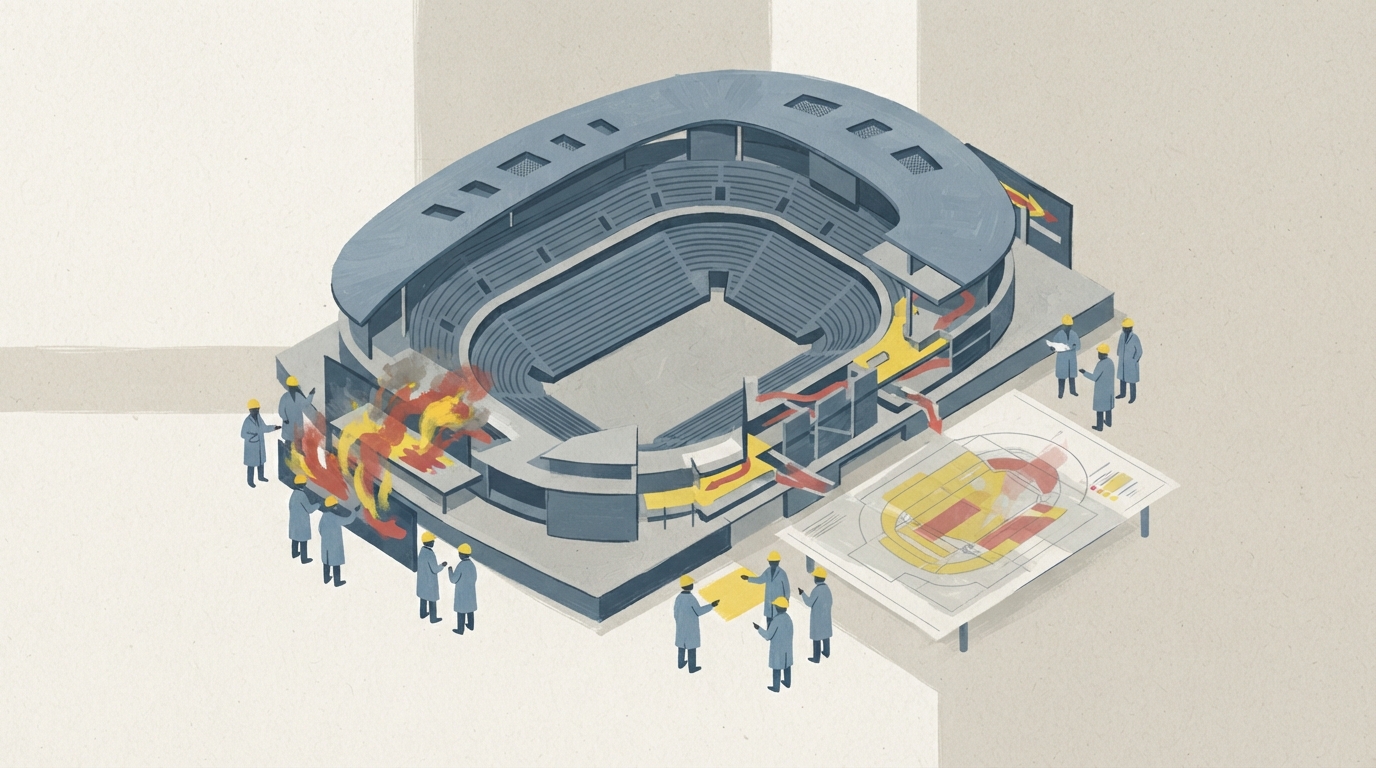
Engineering consultancy Mott MacDonald has examined coupling machine learning with computational fluid dynamics (CFD) tools, such as the Fire Dynamics Simulator, to assist in fire safety design. According to technical principal Tom Lewis, traditional CFD modeling is computationally expensive and can take up to a couple of weeks per run, practically limiting the number of fire and egress scenarios engineers can explore during a live design process. By training machine learning models on automated simulation datasets within engineer-defined parameters, the team tested predictive modeling on a 20,000-seat arena. The approach provided rapid estimations across variable concession layouts, fire sizes, and ventilation constraints, outputting uncertainty measures to indicate where further detailed CFD validation was necessary. Lewis emphasized that AI outputs serve to broaden the evidence base for human judgment rather than replace professional responsibility in safety-critical engineering.
Key takeaways
- Integrating machine learning with Fire Dynamics Simulator allows engineers to predict fire behavior across broader parameter ranges without executing full CFD runs for every design alternative.
- A trial on a 20,000-seat public arena demonstrated that predictive modeling could delineate safe zones for concessions and assist in equipment relocation under spatial constraints.
- Predictions include uncertainty metrics, enabling engineers to identify critical scenarios and target detailed CFD validation only where confidence thresholds require verification.
- Engineering liability remains with human professionals, requiring auditable processes, traceable assumptions, and rigorous verification in safety-critical environments.
Source:Construction Management Read the original ↗
Prepared, checked and automatically published by AI; not individually reviewed by a human.