Next-Gen Embodied AI Infrastructure: Integrated Architecture of AI-RAN and Edge Intelligence
AI assistants · Smart operations · Construction robots
Researchers from ITRI and NYCU published a study in CECI Engineering Technology detailing an integrated architecture combining AI-RAN and edge intelligence. Designed to meet the sub-10ms decision latency required by embodied AI—such as autonomous vehicles, drones, and robots—the framework transforms base stations into distributed computing nodes across four operational layers, incorporating 6G ISAC sensing and network slicing for resilient, low-carbon smart park infrastructure.
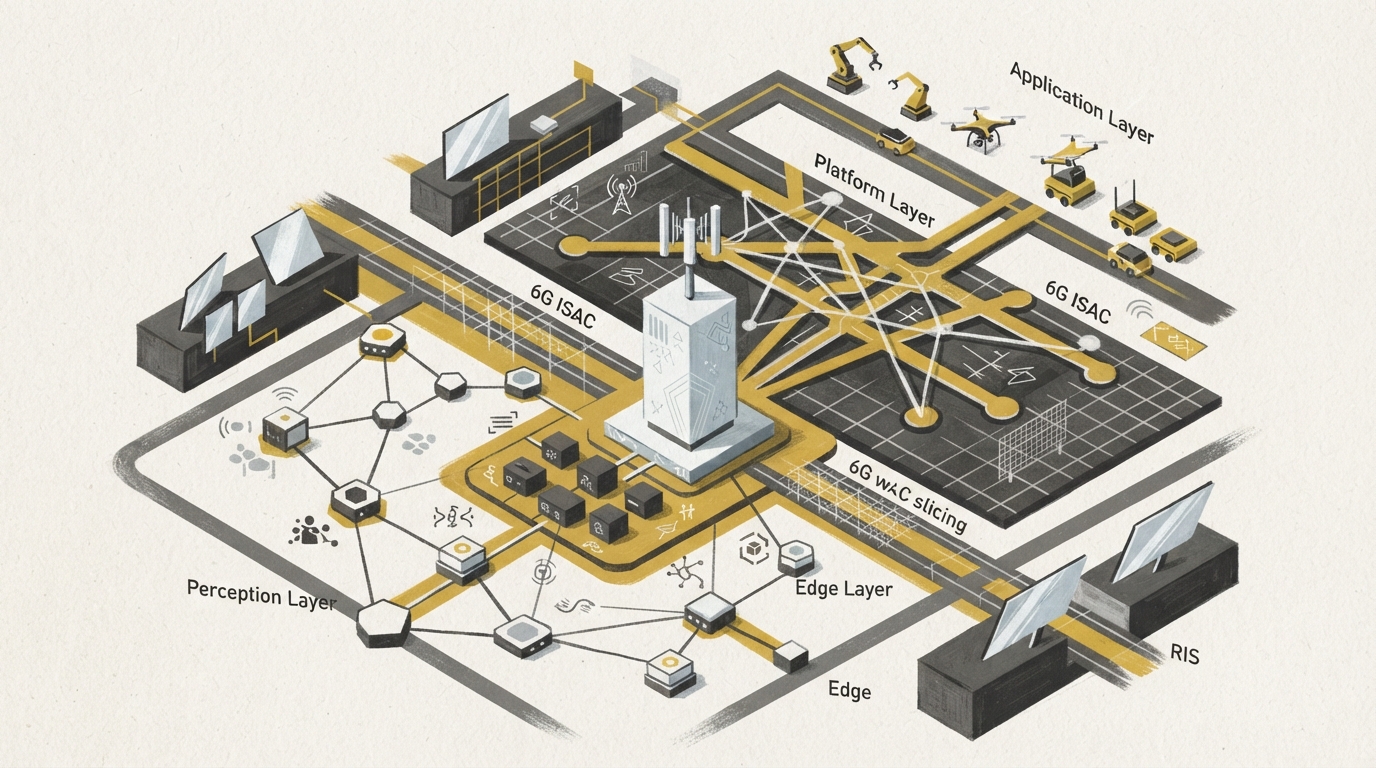
With the rise of embodied AI and physical AI, traditional cloud architectures face network round-trip latencies exceeding 100 ms, failing to meet the 10–100 ms response window necessary for real-time robotic inspection, obstacle avoidance, and industrial control. In the July 2026 issue of CECI Engineering Technology, researchers from ITRI and National Yang Ming Chiao Tung University proposed an integrated infrastructure framework merging AI-RAN with edge intelligence. Built upon open O-RAN specifications, the architecture integrates GPU/NPU accelerators and Multi-access Edge Computing (MEC) into base stations to execute communication and AI inference simultaneously. The design encompasses four functional layers: a perception layer collecting multimodal sensory data; an edge layer executing real-time stream processing and pose estimation; a platform layer using spatio-temporal semantic knowledge graphs and RAG for reasoning; and an application layer managing robots and digital twins via the Model Context Protocol (MCP). The framework also incorporates 6G ISAC, Reconfigurable Intelligent Surfaces (RIS), and AI-driven micro-sleep scheduling to support low-latency, scalable smart infrastructure.
Key takeaways
- AI-RAN deploys heterogeneous GPU computing nodes within O-RAN base stations, overcoming cloud latency and on-device compute limits to achieve decision latencies under 10 ms.
- The four-layer architecture links multimodal perception, edge processing, spatio-temporal knowledge graphs, and MCP-driven application layers for embodied robotic coordination.
- Incorporating 6G ISAC sensing, network slicing, and AI-enabled base station micro-sleep modes can yield 14% to 20% energy savings in specific deployment scenarios while maximizing resource utilization.
Source:中華顧問工程司/台灣世曦|中華技術 Read the original ↗
Prepared, checked and automatically published by AI; not individually reviewed by a human. Translation checked by AI.