G2 Digital Introduces 2U Q-Power Server Supporting Quad Nvidia RTX GPUs
Frontier AI models · Enterprise AI
UK manufacturer G2 Digital has released the 2U Q-Power rack-mount server. Featuring a custom chassis with horizontally mounted GPUs, it supports up to four dual-slot Nvidia RTX cards, targeting on-premise AI workloads and rendering.
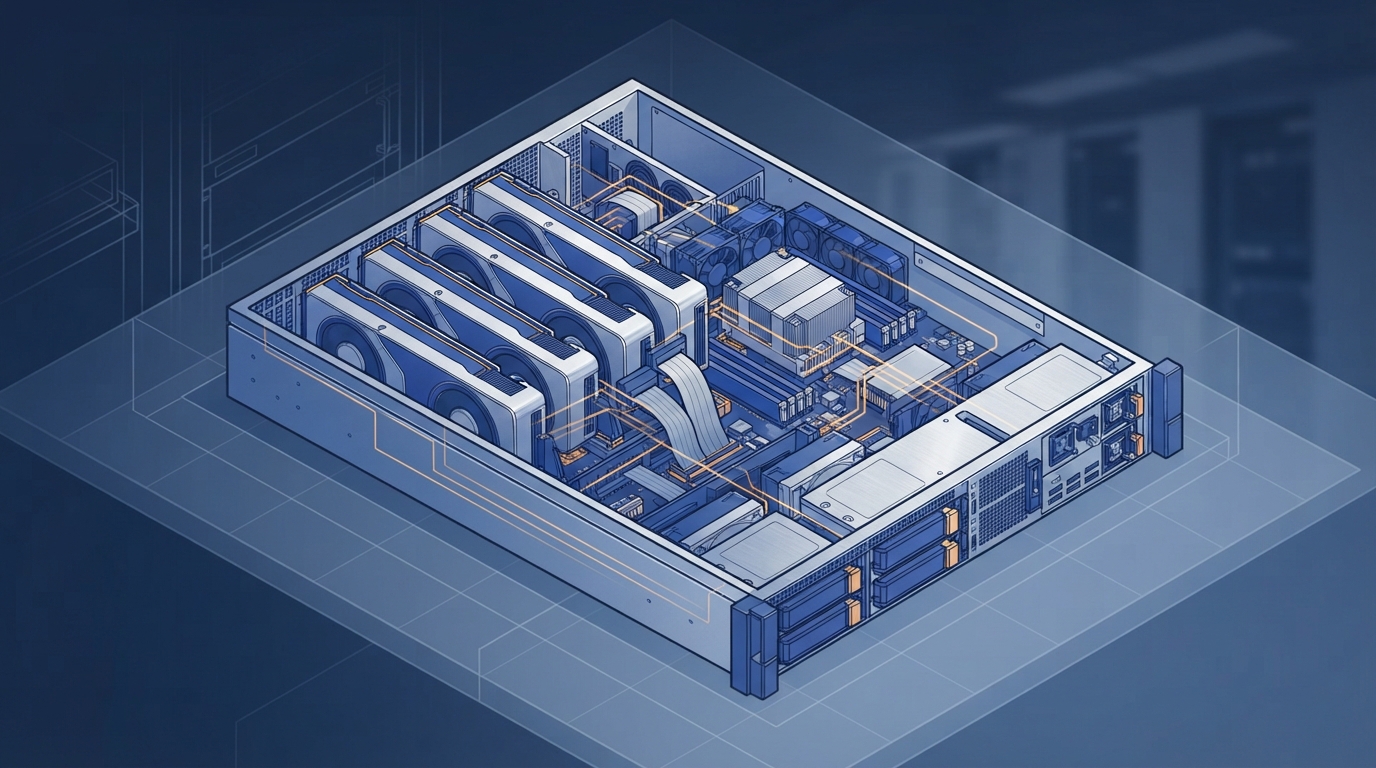
UK custom computer manufacturer G2 Digital has announced the 2U Q-Power, a rack-mount server tailored for on-premise AI workloads and rendering. According to the company, the system utilizes a custom chassis that mounts GPUs horizontally, parallel to the motherboard, allowing it to house up to four dual-slot Nvidia RTX GPUs in a 2U form factor. When equipped with four Nvidia RTX Pro 6000 Blackwell Max-Q GPUs, the server provides 384 GB of combined GPU memory. G2 Digital indicates this setup can run large language models at full precision on-site, as well as larger models using lower-precision formats. The system can also be configured with AMD Epyc or Ryzen Threadripper CPUs, or alternatively up to two Nvidia GeForce RTX 5090 GPUs. G2 Digital positions the on-premise platform as an option for organizations needing local data control and low-latency processing, claiming reduced token costs under sustained workloads compared to premium cloud APIs.
Key takeaways
- G2 Digital launched the 2U Q-Power server, which houses up to four dual-slot Nvidia RTX GPUs via a custom horizontal-mount chassis design.
- Configurations supporting four Nvidia RTX Pro 6000 Blackwell Max-Q cards offer up to 384 GB of total GPU memory, capable of running large language models locally at full precision.
- System options include AMD Epyc or AMD Ryzen Threadripper processors, with alternative configurations supporting up to two Nvidia GeForce RTX 5090 GPUs.
- G2 Digital states on-premise deployment supports data sovereignty frameworks such as GDPR, HIPAA, and SOC 2, while claiming lower latency and sustained token costs compared to cloud APIs.
Source:AEC Magazine Read the original ↗
Prepared, checked and automatically published by AI; not individually reviewed by a human.