Intel Outlines Compute Architecture in Taiwan for Edge PCs, Inference, and Agent AI
Frontier AI models · AI assistants · Enterprise AI
Intel detailed its computing architecture in Taiwan, covering PC, data center inference GPUs, and server CPUs. The Core Series 3 (Wildcat Lake) integrates a 17 TOPS NPU and UCIe on the Intel 18A process for edge devices; the air-cooled GPU D Series (Crescent Island) targets inference cost efficiency; and the next-generation Xeon (Diamond Rapids) offers up to 256 P-cores to handle coordination for enterprise Agent AI workflows.
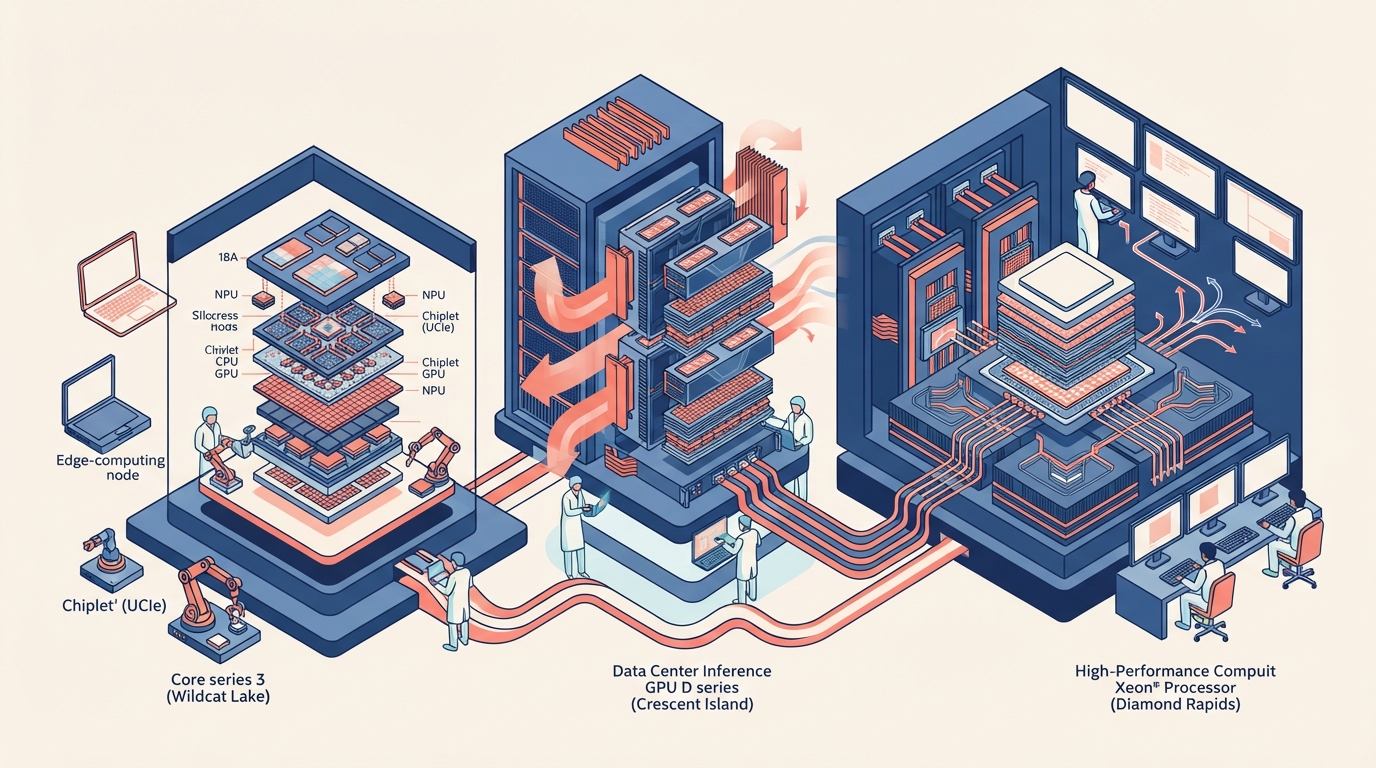
Intel presented its latest computing architecture layout in Taiwan, emphasizing an industry shift from massive model training to inference deployment and enterprise adoption. For client and edge computing, the Core Series 3 processor (Wildcat Lake) leverages the Intel 18A process, integrating Xe3 graphics, updated CPU cores, and a 17 TOPS NPU (with overall platform AI performance around 40 TOPS). It introduces UCIe chiplet interconnects into mainstream processors, targeting smart buildings, robotics, and edge telemetry alongside laptops. For data center inference, Intel highlighted the GPU D Series (Crescent Island), featuring Xe3P architecture, a 350-watt thermal envelope, standard PCIe form factor, and air cooling. It offers up to 480GB of LPDDR5X memory and 1.3 PFLOPS FP8 performance, capable of supporting models with roughly 300 billion parameters on a single card without liquid cooling infrastructure. To address Agent AI requirements involving tool calling and workflow coordination, Intel introduced the upcoming Xeon processor codenamed Diamond Rapids, slated for release next year. Built on Intel 18A-P with Foveros Direct 3D, it scales up to 256 P-cores, 1.28GB LLC, and supports PCIe Gen6 and CXL 3.0 to manage enterprise agent workloads.
Key takeaways
- Core Series 3 (Wildcat Lake) integrates a 17 TOPS NPU and UCIe on 18A, targeting mainstream laptops and edge scenarios including smart buildings and robotics.
- Intel GPU D Series (Crescent Island) focuses on inference economics with a 350-watt air-cooled PCIe design and up to 480GB memory, supporting models with roughly 300 billion parameters per card.
- Next-generation Xeon (Diamond Rapids) targets enterprise Agent AI coordination with up to 256 P-cores, 1.28GB cache, and CXL 3.0 support, expected next year.
Source:iThome Read the original ↗
Prepared, checked and automatically published by AI; not individually reviewed by a human. Translation checked by AI.