Digital Twin and Deep Learning Surrogate Model Applied to Highway 1 Yugang Viaduct
Structures · Smart operations
Researchers from NKUST and CECI Engineering Consultants applied digital twin technology to Taiwan's Highway 1 Yugang Viaduct using ANSYS 3D finite element models, field load tests, and vibration measurements. By integrating vehicle-bridge interaction and a deep learning surrogate model, the system accelerates key response computations to the millisecond scale with errors within ±5%, supporting real-time structural health monitoring and condition-based maintenance via Unity.
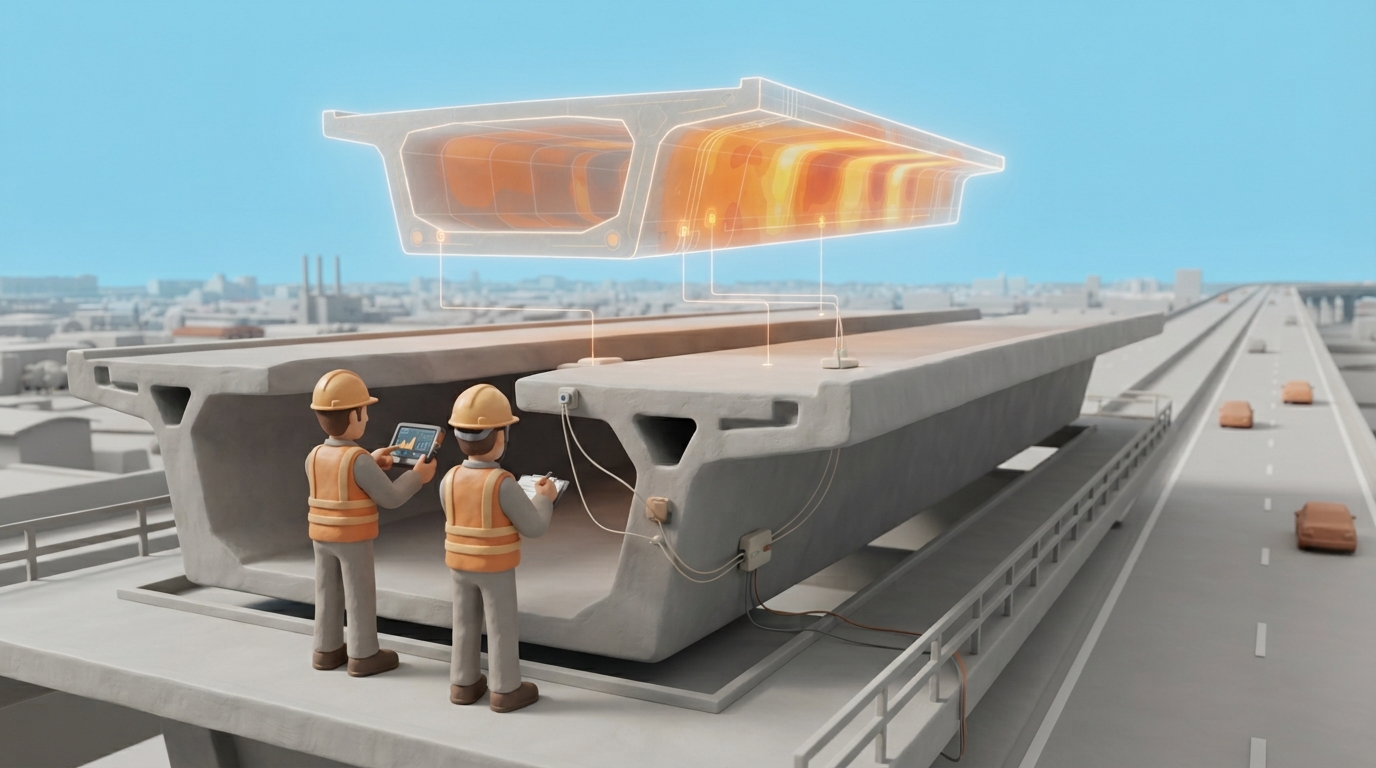
To address aging infrastructure challenges beyond traditional visual inspection, a research team from National Kaohsiung University of Science and Technology and CECI Engineering Consultants investigated the Highway 1 Yugang Viaduct (an S14-S16 three-span continuous box girder bridge) to explore digital twin applications for structural safety monitoring and predictive maintenance. Unlike static geometry-focused BIM, this study established a 3D finite element model in ANSYS calibrated with field vehicle load and vibration data, accounting for vehicle-bridge interaction (VBI) and dynamic torsional loading. To overcome computational bottlenecks of traditional numerical analysis, the study incorporated a deep learning surrogate model. Results indicate the surrogate model reduces computation time to milliseconds while maintaining prediction errors within ±5%, enabling real-time evaluation under high-speed traffic. Furthermore, stress distributions visualized through the Unity platform help engineers assess structural fatigue risks and facilitate the shift from periodic inspection to condition-based maintenance.
Key takeaways
- A 3D ANSYS model of Highway 1 Yugang Viaduct was calibrated with field vibration and load tests to capture vehicle-bridge interaction dynamics.
- A deep learning surrogate model replaced time-consuming finite element analysis, cutting computation time to milliseconds with errors within ±5%.
- Stress distribution visualization via Unity supports the transition from periodic inspection to condition-based maintenance.
Source:中華顧問工程司/台灣世曦|中華技術 Read the original ↗
Prepared, checked and automatically published by AI; not individually reviewed by a human. Translation checked by AI.