DeepSeek Proposes Super-agent Architecture for Cross-Platform Parallel and Event-Driven Agents
Frontier AI models · AI assistants · AI coding
DeepSeek's Harness team published a technical article introducing the Super-agent system architecture. Featuring a dual-layer Router-Worker setup, two-stage event-driven filtering, storage-compute separation, and Watchdog monitoring, the design aims to move beyond single-session constraints to enable persistent presence, cross-channel context synchronization, and parallel execution, though large-scale validation remains ongoing.
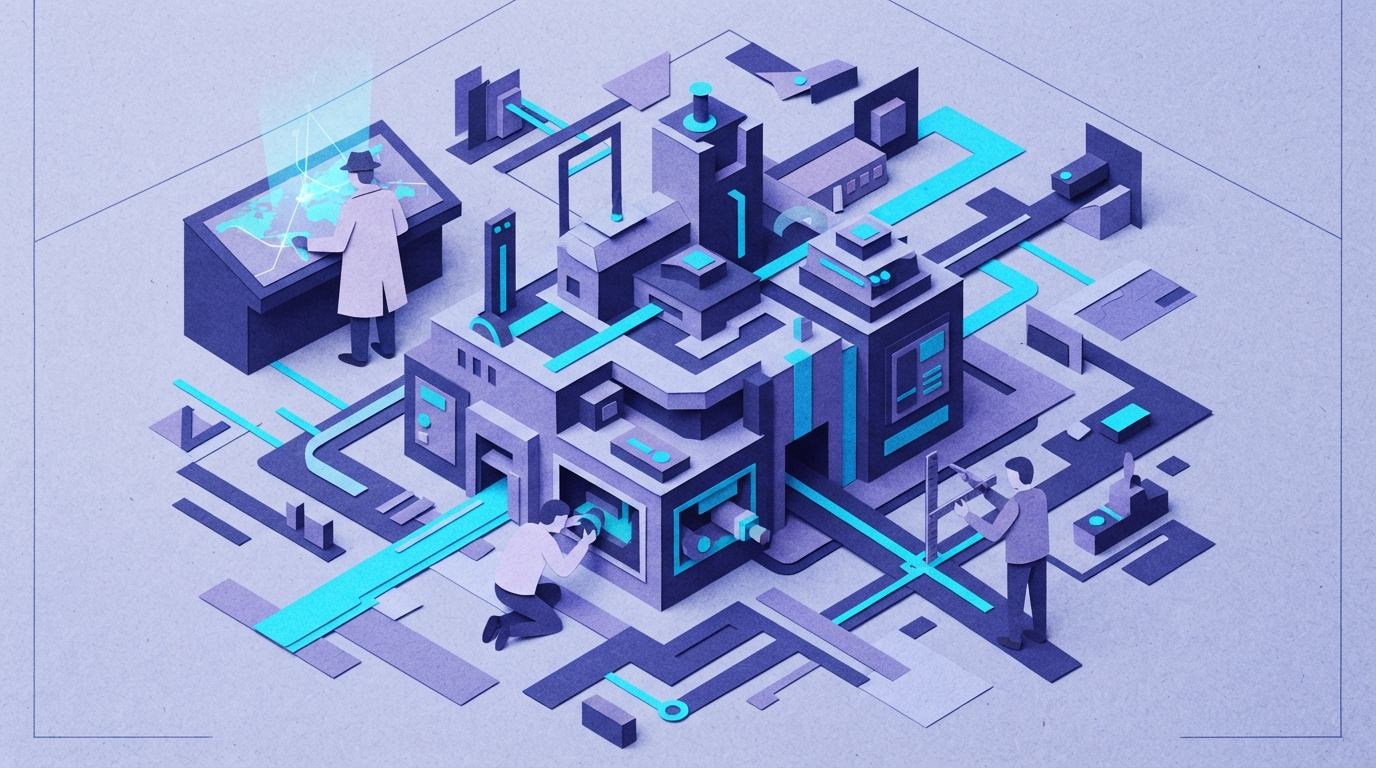
DeepSeek's Harness team has introduced Super-agent, a new agent system architecture designed to overcome the limitations of single-session interactions that hinder multitasking and cross-platform collaboration. The architecture employs a dual-layer approach where a Router maintains context across multiple channels such as messaging apps and code repositories, distributing tasks to independent Worker units for parallel execution. Functionally, the system incorporates event-driven triggers evaluated via two-stage filtering—combining rule-based code filtering and semantic LLM analysis—to mitigate redundant computation, alongside speculative execution. It also adopts a storage-compute separation model, keeping compute instances online in the cloud while accessing local repositories via daemons, complemented by an external Watchdog to prevent stalls or drift. DeepSeek reported that internal agents handle routine bug reproduction and code reviews, though testing remains limited to synthetic workloads, leaving multi-agent coordination and large-scale deployment scaling to be validated.
Key takeaways
- Dual-layer design and cross-channel context: The Router coordinates project context across platforms and assigns tasks, allowing Workers to execute independently in parallel.
- Event-driven mechanism and two-stage filtering: Continuous monitoring processes environmental triggers through fast code rules and slower semantic evaluations to curb inference overhead.
- Storage-compute separation and Watchdog monitoring: Cloud compute and database states are decoupled, while an external Watchdog oversees Worker execution to avert infinite loops or task deviation.
- Internal deployment status and scaling challenges: While operational internally for bug reproduction and code reviews, benchmarks rely on synthetic data, leaving larger-scale coordination to be verified.
Source:INSIDE Read the original ↗
Prepared, checked and automatically published by AI; not individually reviewed by a human. Translation checked by AI.