Analysis of Diaphragm Wall Construction Defects and Deviation Control Techniques
Construction methods · Project management
An article in the Taipei Structural Engineers Association forum analyzes diaphragm wall breaches and sinkhole causes. As synthetic polymers replace bentonite, defect causes have shifted from slurry contamination to trench collapse during pouring. Maintaining hydraulic differential, preventing slurry loss, and ground improvement are key. For male-female panels subject to unbalanced pressure, the author outlines stone backfill risks and proposes a tie-back cable method.
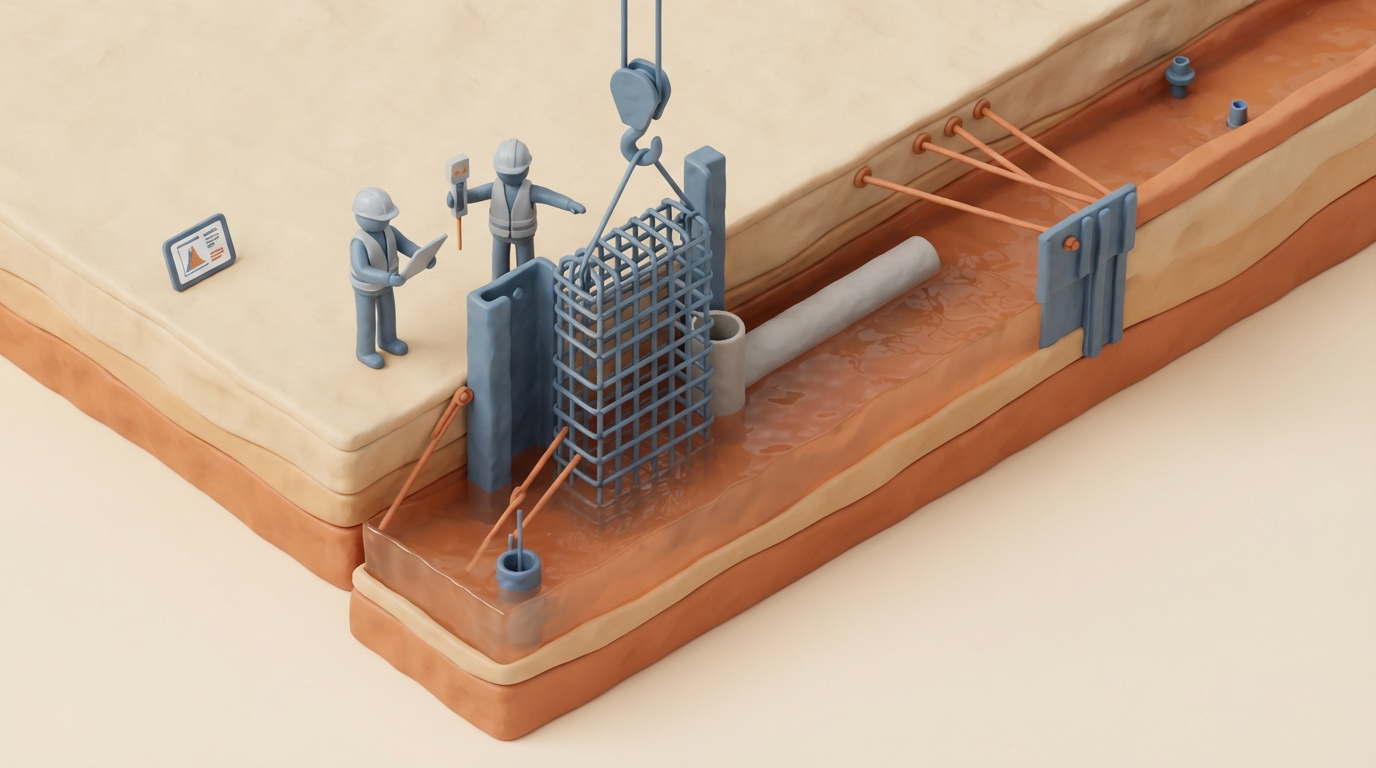
An engineering paper by Dr. Chuan-Chih Liu, published by the Taipei Structural Engineers Association, analyzes the mechanisms and preventive techniques concerning diaphragm wall construction flaws in deep excavations. While early failures under bentonite slurries were predominantly driven by slurry degradation and mud inclusion at joints, the transition to synthetic polymer slurries and optimized tremie pipe placements has shifted the predominant risk to trench instability. Contemporary wall breaches leading to sinkholes are mostly caused by trench collapse during concrete pouring, entrapping collapsed soil into the concrete mass. Trench stability is governed by soil mechanics, groundwater pressure, slurry properties, and panel trenching length. In sandy strata, maintaining a hydraulic head difference of roughly 2 meters between the slurry level and the groundwater table is critical. In confined aquifers or partitioned enclosed basements, decompression wells combined with observation wells must be configured to balance pressures without causing drawdown-induced settlement. For highly permeable gravel layers prone to sudden slurry loss, pre-grouting or soil replacement must be executed prior to excavation, alongside trench stabilization techniques for weak cohesive soils. Regarding male-female panels (starter-closing units with only one bulkhead endplate), unbalanced concrete pressure during tremie placement often induces cage displacement and bulkhead deformation. This defect compromises horizontal lap splices, distorts main reinforcement spacing, and impedes joint clearing in adjacent panels. While traditional stone backfilling poses the risk of drawing fine soil into fresh concrete, the article details a tie-back cable method that anchors the bulkhead to the ground deck or adjacent panels, effectively restraining deformation for panel depths within 25 meters.
Key takeaways
- Diaphragm wall defect mechanisms have shifted from early bentonite slurry inclusion to trench collapse during tremie placement (soil engulfment).
- Stabilizing trenches requires maintaining at least a 2-meter head differential, deploying decompression and observation wells in high-water zones, and pre-treating permeable layers.
- Unbalanced lateral pressure on male-female panels frequently causes bulkhead deformation and cage shift, compromising joint rebar continuity and cleaning.
- To counter male-female panel deviation, clean backfill aggregate standards must be enforced, or a tie-back anchoring method utilized to restrain displacement within 25-meter depths.
Source:台北市結構技師公會|結構論壇 Read the original ↗
Prepared, checked and automatically published by AI; not individually reviewed by a human. Translation checked by AI.