NVIDIA Unveils GR00T 2 and Open Simulation Tools for Dexterous Robot Manipulation at CoRL
Frontier AI models · AI assistants
At the Conference on Robot Learning (CoRL), NVIDIA introduced new open robotics tools and models focused on precise physical manipulation. Key announcements include GR00T 2, an open world action model trained on human and robot data, Isaac Lab 3.0 featuring tighter integration with the Newton physics engine, new benchmarks like DexBench and VABAR, and agentic workflows such as UC Berkeley's Graph-as-Policy framework for generating interpretable robot control programs.
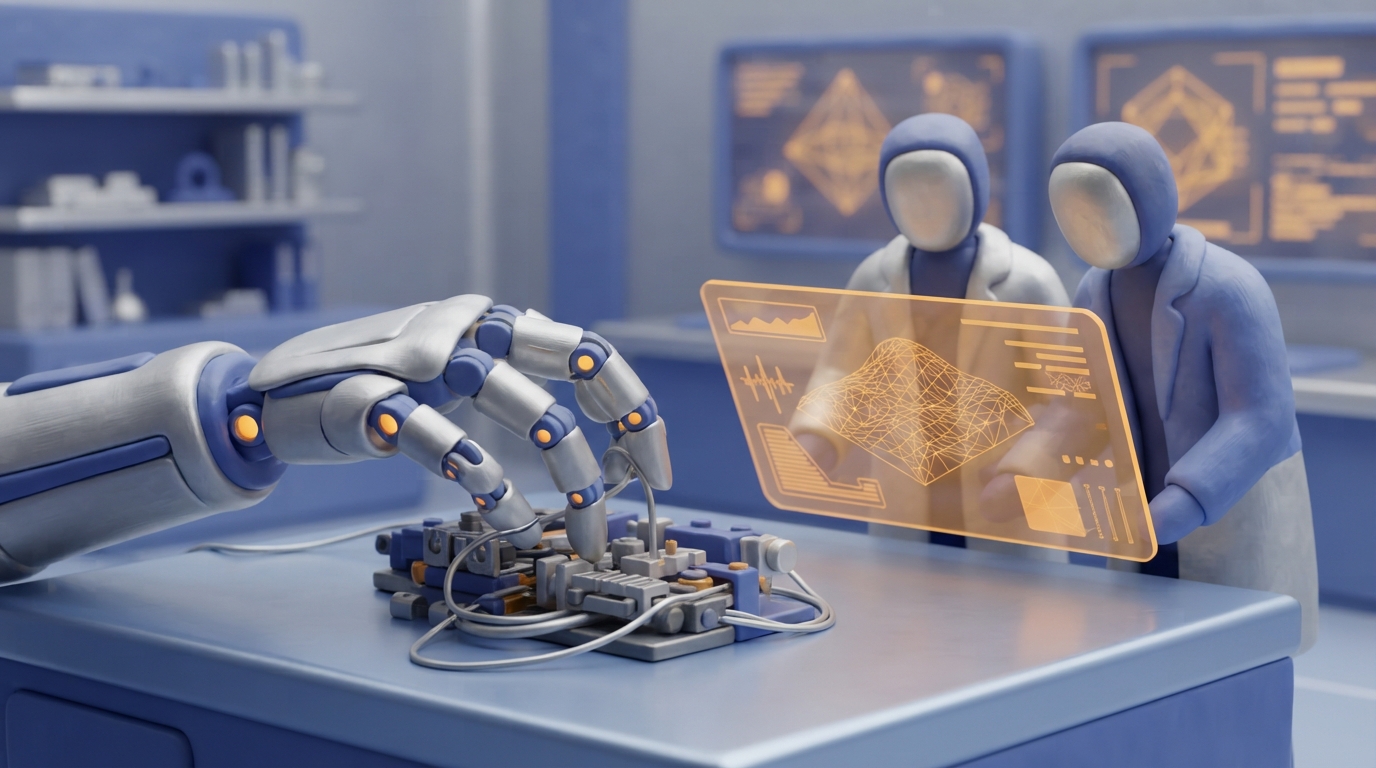
At the Conference on Robot Learning (CoRL) in Austin, Texas, NVIDIA presented an array of open robotics tools, foundation models, benchmarks, and agentic workflows aimed at moving robots from basic locomotion to complex, dexterous manipulation tasks like component assembly and cable handling. Central to the release is GR00T 2, an open world action model built on NVIDIA Cosmos. Trained on robot data and 100,000 hours of egocentric human video, the model completed 40 of 50 evaluated tasks out-of-the-box without task-specific demonstrations, reaching a 71% average success rate with one demonstration and 95% with five demonstrations per task across the test set. Industrial partners including Foxconn, Siemens, and Nexuni are testing GR00T 2 across server manufacturing, logistics, and factory automation workflows. On the simulation side, NVIDIA announced Isaac Lab 3.0, incorporating deeper integration with the open-source Newton physics solver. According to NVIDIA, Isaac Lab 3.0 with Newton achieved up to 2.5 times the training throughput of Isaac Lab 2.3 with PhysX in a vision-based manipulation benchmark, enabling realistic simulation of deformable objects like cables alongside multi-jointed robotic hands. Additional developments include the developer preview of Isaac Lab-Arena 0.4 for parallel failure analysis, new benchmarks DexBench and VABAR, and the Graph-as-Policy (GaP) framework developed with UC Berkeley, which uses AI agents to chain individual skills into verifiable, interpretable code for physical robot execution.
Key takeaways
- NVIDIA introduced GR00T 2, an open world action model that achieved a 71% average success rate across 50 manipulation tasks with a single human demonstration and 95% with five demonstrations.
- Isaac Lab 3.0 integrates the open-source Newton physics engine to model deformable objects and multi-joint hands, reportedly achieving up to 2.5 times higher training throughput than Isaac Lab 2.3 with PhysX.
- New open evaluation frameworks and benchmarks include Isaac Lab-Arena 0.4 preview, DexBench for industrial dexterity, and VABAR from UC Berkeley and NVIDIA.
- UC Berkeley introduced the Graph-as-Policy (GaP) framework, using AI agents to orchestrate individual manipulation skills into interpretable, testable robot programs.
Source:NVIDIA Blog Read the original ↗
Prepared, checked and automatically published by AI; not individually reviewed by a human.